 Car insurance
 Telematics
 Van insurance
 Home insurance
 Car finance
driving in the uk
10 surprising UK driving laws
From keeping your car clean to driving with your dog. Get to know some of the odd, unique and lesser-known laws for driving in the UK.





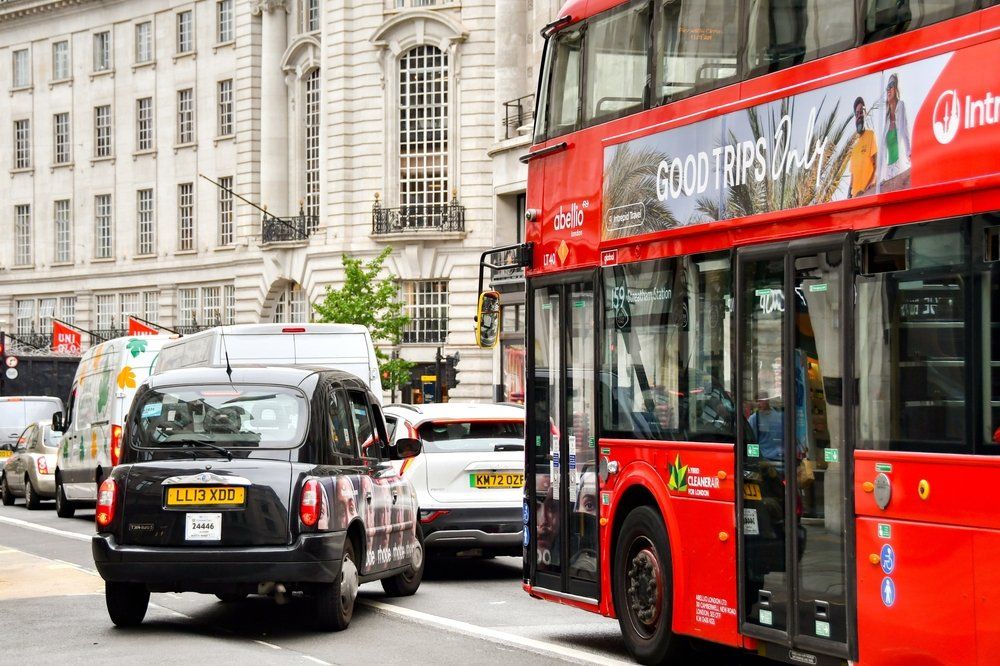

Over 40% of London’s residents were born overseas, so you’re in good company if you’ve chosen the capital for your UK home.
You don’t need a car to enjoy London’s study and work opportunities, or to reach most of its famous landmarks. In fact, about half of Londoners don’t have a car at all.
But if you’ve brought your car with you or got one here, we’ve got all the local knowledge for driving and parking in London.
Need insurance? Get low-cost car insurance in minutes with Marshmallow.
These are our top tips for navigating London by car:
An increasing number of roads within London boroughs have a speed limit of 20 miles per hour (mph). This can change from road to road, so it’s easy to get confused and accidentally creep over the limit. Unfortunately, London’s speed cameras are great at catching out mistakes like this. Even long-time locals get caught out regularly.
To avoid a fine or points on your licence, keep a careful eye on the speed restriction signs (red circles with a number inside). And pay attention to your sat nav — they usually stay up to date with the latest speed restrictions.
Bus lanes are everywhere in London and can look temptingly empty compared to the other lanes.
Don’t use them to take a short cut. Bus lanes have cameras and you’ll be fined if you drive down one when you shouldn’t.
Each bus lane has hours of operation – look out for the blue signs. You can drive in bus lanes outside of their hours.
But if in doubt, stay out.
Red lines down the sides of the roads keep traffic flowing in London.
These ‘red routes’ are unique to London and a few other cities around the UK, so not everyone understands them.
Red lines mean no stopping, even for unloading. A single line means the red route has certain hours. A double red line means no stopping at any time, day or night.
Yellow boxes on junctions are another common London feature. The rule is simple: make sure there’s room to leave the other side of the yellow box before you enter it. If you obstruct traffic by getting yourself stuck in a yellow box, you risk a fine.
The trick to parking in London is planning and preparation. A local friend who knows all the best spots helps too.
The closer you get to Central London, the more difficult parking is. That’s why most people switch to public transport before they get anywhere too close to Soho and Trafalgar Square.
These are your main choices:
Street parking is in short supply in most parts of London and is often reserved for residents.
Most London Streets are controlled parking zones. You need to read the signs on the street to find out when you’re allowed to park and how much it’ll cost.
Some will have free parking at certain times of day, or for a short time like up to two hours. Otherwise there’s usually a meter nearby to pay.
London streets are busy, so it’s usually easier and safer to take a spot in a car park.
Lots of car parks have a website or app that lets you book online. You’ll probably need to do that to get a space at all in Central London.
A great way to save money on London parking is to try websites like JustPark and ParkOnMyDrive where people rent out their own parking spots.
No, it’s not a myth – it is possible to park for free in London.
In theory, there is free street parking even in the City of London after 11am on Saturday and all day on Sunday. In practice, you’ll probably struggle to find a space.
Outside the centre each borough sets its parking rules, but it does get easier to find free on-street parking the further out you go.
You can also get free parking for an hour or two when you use some shops and supermarkets.
Two things that can push up the cost of driving in London are the congestion charge and the Ultra Low Emissions Zone (ULEZ).
There are cameras all over London’s roads to check every vehicle and automatically issue charges.
You don’t need to worry about ULEZ unless you have an older car.
ULEZ charges usually apply to petrol cars built before 2005 and diesel before 2015, but you’ll need to check your vehicle to be sure.
And if you’re buying a car to drive here, check whether it’s ULEZ-exempt before you do.
The ULEZ covers all London Boroughs and the city of London. There’s a £12.50 daily charge for driving in the ULEZ if you have an older, high-emissions car.
If your car’s from outside the UK, it might not be on Transport for London’s system. Don’t worry – you can still be exempt from the charge if you can provide evidence that it’s a low emissions vehicle.
The latest 2024 figures show that 96% of vehicles driven in the ULEZ meet the emissions standard, but if yours is one of the few that don’t you need to pay the charge within three days of the journey.
Inside the ULEZ, there’s the congestion charge zone. It’s a 21 square kilometre area of Central London.
You have to pay £15 a day for driving in the congestion charge zone:
Good news if you drive an electric car – you can apply for a Cleaner Vehicle Discount of 100% until December 2025. And if you live within the Congestion Charge boundary you can claim a 90% discount.
London has lots of measures to encourage electric cars (EVs), including:
The main drawback of an EV in London is that you’re less likely to have your own driveway where you can charge at home. Public charging points are really common, but it’ll cost more to charge up.
You need to be aware of car crime in a city the size of London. In the 12 months up to 31 October 2024, 33,881 cars were stolen. There were also 57,557 thefts of property from vehicles.Use these tips to keep your car safe:
Enfield, Newham and Ealing were the worst hit spots for vehicle crime. Kingston upon Thames, Sutton and Merton proved to be the safest boroughs for cars.
You might prefer to avoid the stress and expense of Central London driving altogether.
A great London tip is to only drive as far as one of the outer Tube or train stations, then switch to public transport.
There’s even a public bike hire scheme if you prefer. By combining car travel with Tube or bike like this you take out the most stressful part of London driving – and hopefully get from A to B much quicker at rush hour.
From keeping your car clean to driving with your dog. Get to know some of the odd, unique and lesser-known laws for driving in the UK.
When you’re new to driving in the UK, it’s easy to make mistakes. The road signs can be confusing, the roundabouts are enough to make your head spin.

From the polite to the puzzling – some things UK drivers do don’t seem to make sense. Find out what it all means with these seven unwritten road rules explained.